Product Principles
Why Design Matters Just as Much as AI in Modern Compliance
How Quantifind’s SVP of Design thinks about turning speed, accuracy, and scale into real outcomes by reducing friction in how decisions are made, understood, and trusted.

Lance Rutter
SVP of Design
For all the conversation around artificial intelligence in financial crime, one truth does not get nearly enough attention: innovation is only as powerful as the experience that delivers it. At Quantifind, breakthroughs in speed, accuracy, and scale only come to life through something just as essential: Design. Clean workflows, intuitive navigation, and interfaces that investigators actually enjoy using are not nice-to-haves. They are force multipliers that determine whether the intelligence reaches analysts quickly, clearly, and with confidence.
Few people understand this more deeply than Lance Rutter, Quantifind’s SVP of Design, who has shaped the look, feel, and usability of our platform for more than a decade. Customers often tell us they adopted Quantifind for the accuracy but stayed for the user experience. In this conversation, Lance explains the design philosophy behind the product, how customer feedback informs every choice we make, and why breaking from legacy system conventions is essential to enabling modern compliance teams.
Q&A with Lance Rutter, SVP of Design
Quantifind is known for speed, accuracy, and scale. How does design act as the bridge that makes those capabilities usable?
Lance: For most companies that build SaaS applications, it isn’t actually true that design is just as essential as measurable outcomes like throughput or accuracy. From the beginning, Quantifind has taken a different view. We’ve always recognized that our users aren’t machines—they’re people operating in a physical world full of emotion, pressure, and imperfection.
When you start from that belief, design becomes the way those outcomes show up in reality. Speed, accuracy, and scale are potential. They’re important, and our technology is exceptional at them, but they’re not what people actually use. What people use is the interface. Design is what turns that potential into something an investigator can trust, understand, and act on with confidence.
If someone can immediately see what matters, understand why it matters, and feel confident enough to act, that’s when speed becomes a fast outcome—not just a fast model.
Can you walk us through your design philosophy? What core principles guide the Quantifind experience?
Lance: I don’t think of design as a toolkit or a checklist of components. For me, it’s a set of guiding principles—design axioms—about how we bring clarity and meaning into the world.
You’ve probably heard the phrase “form follows function,” meaning the shape of something should be dictated by what it does. That’s true as far as it goes. But in the 21st century, I also believe that form follows emotion. How we communicate is deeply tied to how people feel—their pain points, their hopes, their satisfaction, even their joy.
Great design doesn’t just work well. It feels right.
I often remind the team of two aphorisms: “The devil is in the details,” and “God is in the details.” One is a warning that small things can hurt you if you ignore them. The other is a reminder that delight and meaning often emerge from subtle, carefully considered choices. Design lives in that tension between caution and joy.
Form, Meaning, Purpose
Design should always explain what’s happening. As Lance puts it, “When you’re waiting on a system, the last thing you want is to wonder whether it’s broken. Generic loading spinners do exactly that. They signal delay without meaning. At Quantifind, we treat even in-between states as moments worth designing. If we cannot tell you exactly how long something will take, we can at least show that real work is happening: connections forming, patterns emerging, intelligence taking shape. Design should feel honest. It should reflect what the system is actually doing. Every form should express its purpose.”

Left: A traditional loading spinner; Right: Graphyte’s Relationship Network load animation.
Financial crime work is mentally demanding. How does design help reduce cognitive load for investigators?
Lance: Our users don’t experience our AI—they experience our interface. What’s shown, what’s hidden, what’s emphasized, and what feels obvious versus what feels like homework all shape their experience.
Financial crime work is already mentally exhausting. If your software adds friction—extra clicks, scattered views, inscrutable terminology—you’re not helping. You’re just piling on. Good design does the opposite. It removes noise. It creates hierarchy. It gives your eyes and your brain a clear path through the data.
When that happens, accuracy stops being a statistic and starts being something you can actually feel.
Legacy compliance systems are notoriously cumbersome. What design decisions did we make early on to move away from those patterns?
Lance: Most legacy compliance systems were built when raw data was the star of the show. Interfaces were carved into tabs, pages, and buried panels just to display as much information as possible. The result is what I think of as enterprise claustrophobia—you’re always one click away from what you need, but never quite there.
We deliberately went another way.
We unified views. We put relationships, risk, and evidence in the same visual field so meaning could emerge without a scavenger hunt. The network graph wasn’t a design flourish—it reflected how investigators actually think, which is in patterns and connections, not rows.
Filters weren’t just controls; they became a way to ask the data questions and get immediate answers. The guiding principle was simple: if something is important, you should be able to see it. Not go looking for it.
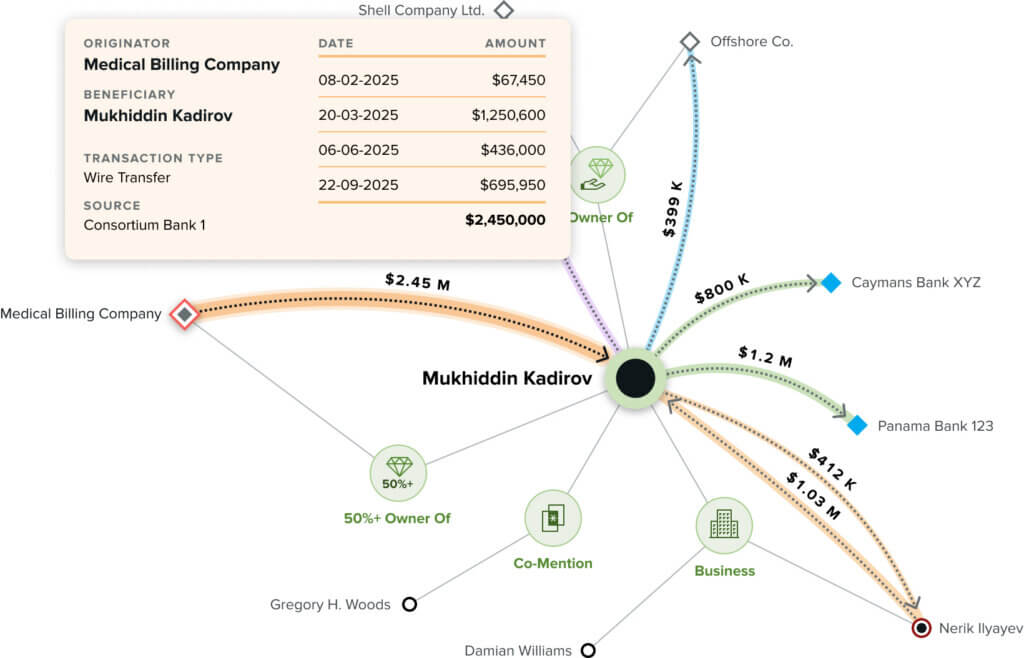
A unified relationship network surfaces risk, ownership, and transaction patterns in a single view, reflecting how investigators naturally think in connections rather than rows.
Quantifind’s customers often say the interface “just makes sense.” How do you collect user feedback and bring it into the product?
Lance: That kind of feedback doesn’t come from guessing—it comes from listening.
Our product managers and customer success teams have close, ongoing relationships with the people who use our software every day. We see where users hesitate, where they get lost, and where they invent clever workarounds. That’s design feedback in its purest form.
When someone with a design mindset is listening, they’re not just collecting responses. They’re also sensing what isn’t being said and shaping it into what the product could become. Over time, those moments influence everything—from where a button lives to how we explain “accuracy” in our metrics and how we define risk typologies.
One early customer even called Graphyte the “Cadillac” of investigative software—an admittedly 1970s metaphor—but what they were really recognizing was a level of craft and quality that simply didn’t exist elsewhere in the market.
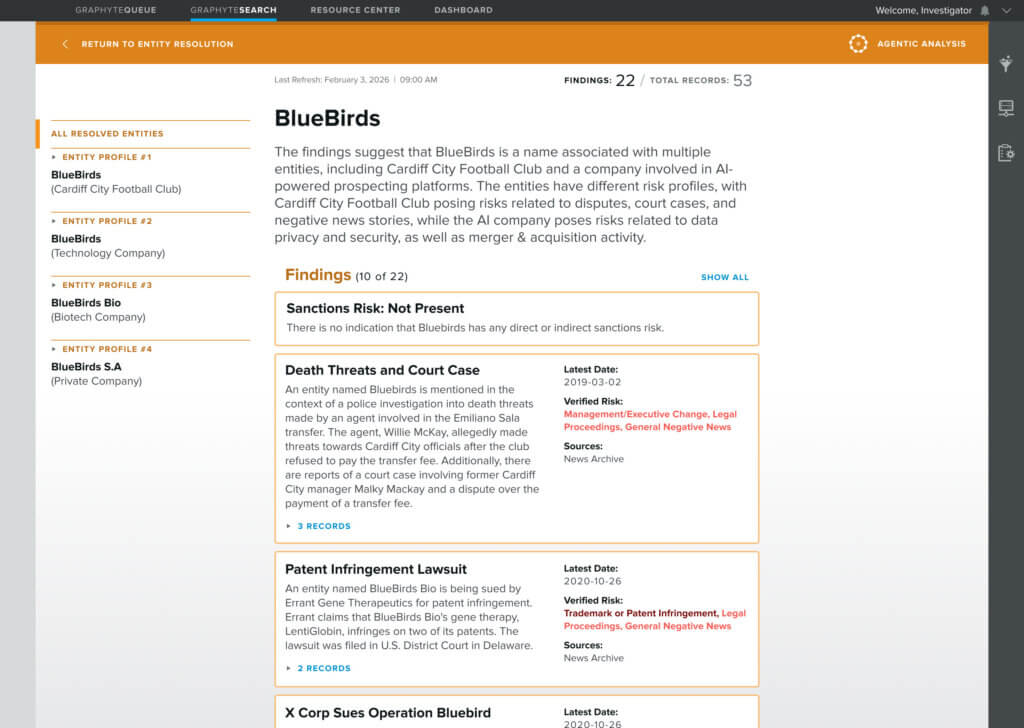
AI-powered summarization presents key findings, sources, and risk signals in a layout designed for fast understanding and confident decision-making.
How do you think about designing for both analysts and managers, who often have very different needs?
Lance: We don’t solve that by making two different products. We solve it by layering the experience.
Analysts need speed and precision. Managers need visibility, auditability, and peace of mind. Good design doesn’t flatten complexity—it organizes it. That means streamlined flows for the people doing the work, paired with clear, trustworthy summaries and reports for the people responsible for the outcomes.
When design is done well, both groups get what they need without stepping on each other.
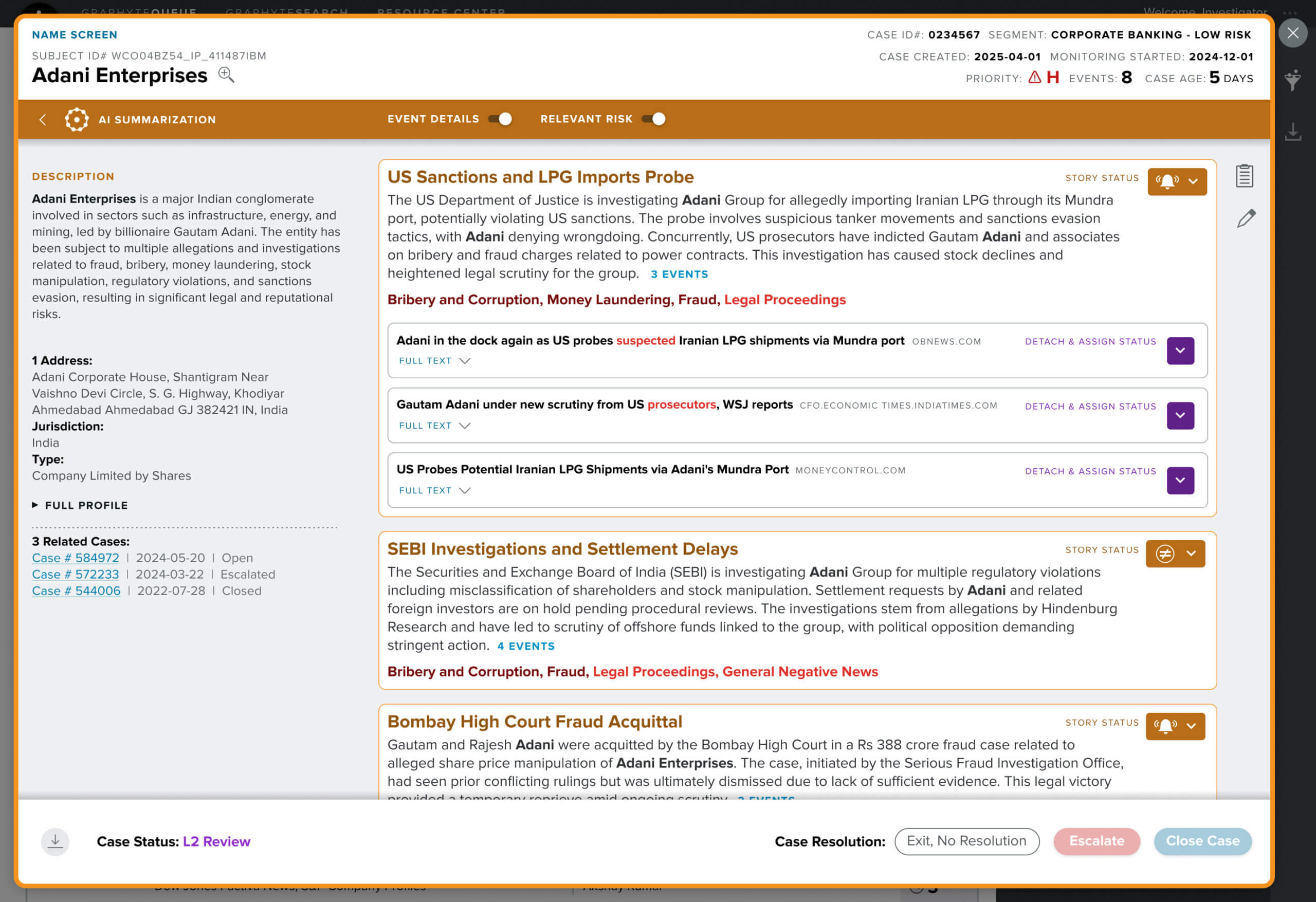
AI-generated case summaries help analysts quickly distinguish high-confidence signals and prioritize their work without sacrificing context.
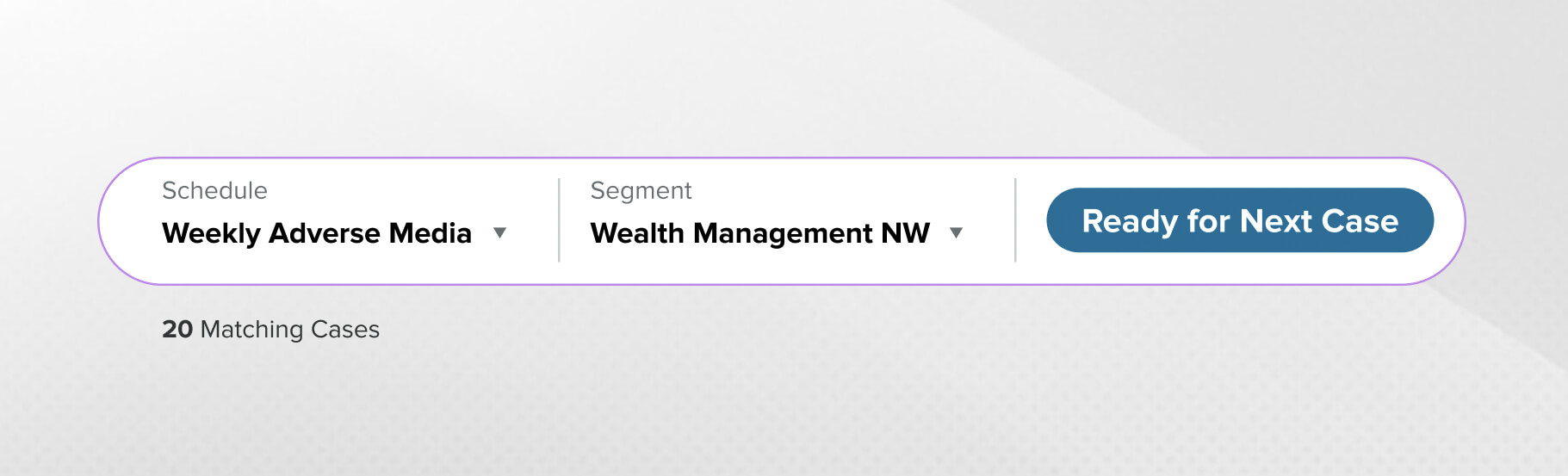
Graphyte’s UI makes it easy for analysts and investigators to move through their case workload.
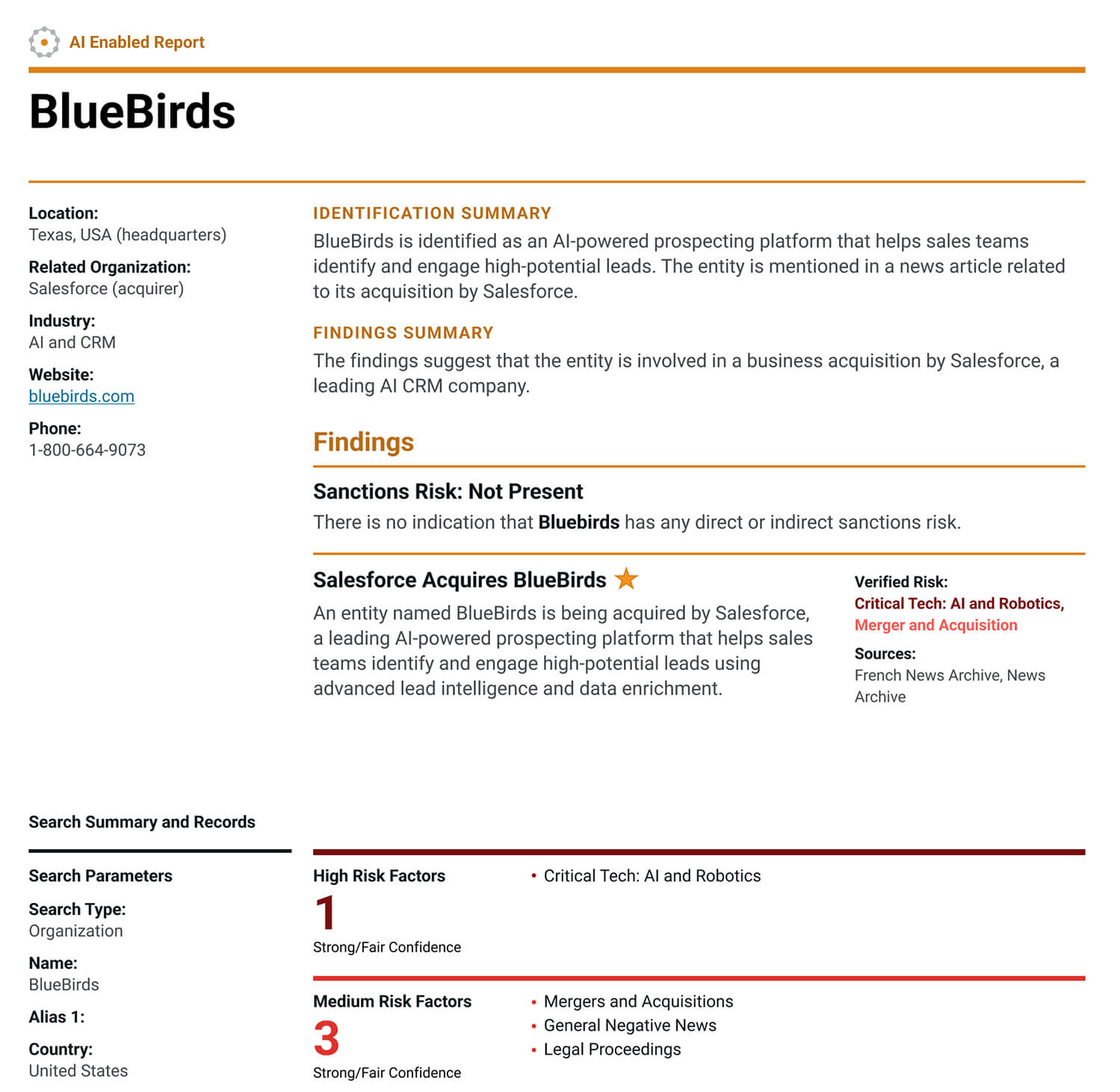
A manager-ready report summary translates complex analysis into clear, auditable insights that support oversight and confidence.
AI is becoming more central to financial crime compliance. How does design shape the way humans interact with AI at Quantifind?
Lance: We’ve been using machine learning in our data science for years, but putting AI in front of humans is a different challenge. It’s not enough for a model to be right—someone has to understand what it’s saying and why.
That’s why our summaries, confidence indicators, and explanations are designed as much as they are engineered. They create a conversation between human judgment and machine assistance, instead of pretending one can replace the other.
As systems become more powerful, design becomes even more important. The future isn’t flashy interfaces—it’s context, anticipation, and explanation. Helping someone understand not just what the system thinks, but how it got there and what they should probably do next.
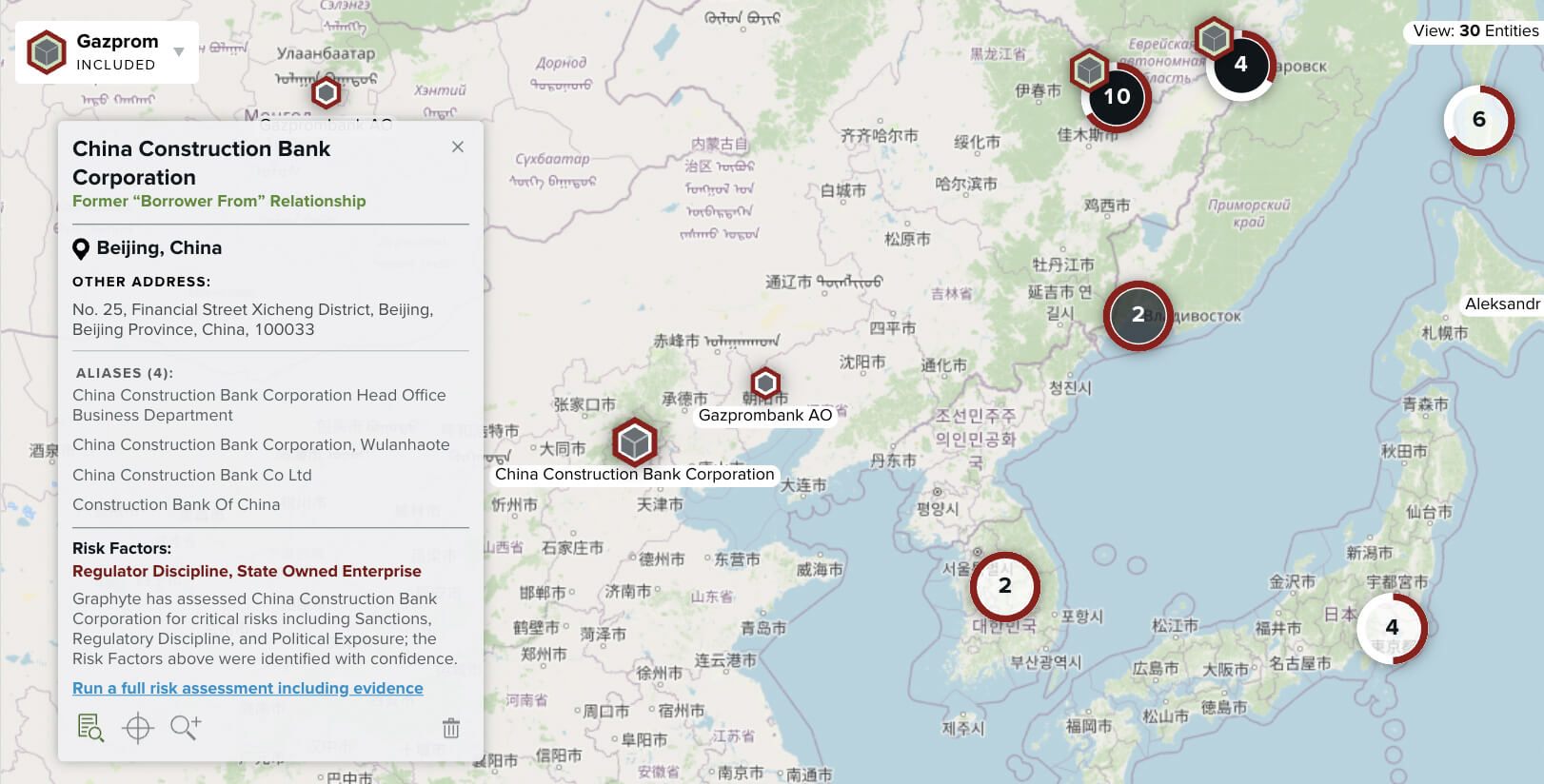
A geographic view of relationship risk provides spatial context, helping investigators and managers understand how risk is distributed and connected across regions.
Finally, how do you know when design is truly working?
Lance: There’s something no dashboard can measure, but every great product depends on: how it feels to use.
One of my favorite questions to ask customers is, “How would you feel if we took this away and made you go back to what you used before?” The answers are rarely technical. They’re emotional. That groan—that flash of dread—is actually the best compliment we can get.
It means the software has become part of how they think.
That’s what we’re building at Quantifind. Not just interfaces. Not just AI. But a way of working that feels clear, capable, and—maybe most important—human, in a world that often doesn’t feel that way.
Closing
Design is the connective tissue that transforms powerful AI into investigator impact. It determines how quickly insights are understood, how easily decisions are made, and how trustworthy the intelligence feels. Quantifind’s investment in design is one of the reasons customers consistently tell us our platform is a pleasure to use, even in the high-pressure world of AML, KYC, and sanctions.
If you want to see how thoughtful design and advanced AI come together, the best way is to try it yourself.
Explore the interactive demo of Graphyte Queue and experience the design behind Quantifind’s intelligence.