By: Amanda Wilcox, Krish Gaglani, and Jason Palleschi
Transaction screening helps identify potential sanctions matches, but understanding exposure to sanctions risk requires examining the activity behind a transaction, including:
- where the money came from
- what activity is being financed, and
- whether that activity is permitted at the time of the transaction.
September’s sanctions developments illustrate why those questions matter. Payments routed through third countries, restrictions on Sudanese gold, and changes to Iran authorizations each reveal a different challenge that list matching alone cannot resolve.
Sanctions teams need evidence to understand the activities their clients are engaged in and explain their risk decisions. That is why sanctions compliance does not end with list matching.
A payment’s route does not tell the whole story
On September 10th, OFAC announced a $1.43 million settlement with an individual involving apparent violations of Iran sanctions. The activities included receiving Iranian-origin dividends in U.S. bank accounts through banks in Türkiye, the United Arab Emirates, and Singapore.
The individual had co-founded an Iranian software company, maintained business connections with its leadership, and purchased four properties in Iran.
Although the settlement concerned the individual, the payment routes illustrate a practical challenge for banks: the immediate sender and originating bank may not reveal the underlying source of funds.
Understanding a customer’s source of wealth, business interests, and payment activity can help investigators identify connections that warrant further review. Relevant questions include:
- What is the customer’s source of wealth?
- What business activity is the customer involved in?
- How do incoming and outgoing payments fit with what the institution knows about the customer?
Screening remains necessary, but investigators also need enough context to evaluate the activity behind the names.
The goods being financed can matter as much as the parties
Switzerland’s September restrictions on Sudanese gold provide another example. Effective September 10th, the measures prohibit the purchase, import, and/or transit of gold originating in Sudan, along with related services and financial assistance.
Here, checking the buyer and seller against sanctions lists does not resolve the entire question. An institution subject to these restrictions and engaging in activity involving gold may also need to establish the gold’s origin and determine whether its financing or services support a prohibited activity.
Investigating the refineries and intermediaries involved can reveal additional questions. Adverse media or government actions concerning past sourcing practices may warrant further review, although they do not establish the origin of the gold in a current transaction.
Company intelligence and relationship data can help investigators identify relevant connections, while trade documents provide evidence about goods and their origin.
This is where sanctions work intersects with trade finance, customer due diligence, and transaction monitoring. The relevant information often sits across several teams and systems.
A familiar transaction may need a fresh review
Sanctions exposure can also change when permissions change.
Effective September 8th, OFAC suspended certain authorizations and a licensing policy involving Iran, including those covering payments for overflights of Iranian airspace, aircraft safety, bunkering and emergency repairs, and temporary visits by certain civil aircraft. OFAC also issued a limited wind-down authorization for certain previously authorized activities, subject to conditions and a September 23rd deadline.
The lesson extends beyond this particular action. A transaction does not remain permissible simply because the institution processed a similar one before.
Teams need to understand which authorization supported an activity, whether it still applies, and what the change means for current customers and transactions. Updating a sanctions list addresses only part of that work.
Reviewing affected activity requires understanding the applicable prohibitions, any relevant licenses or exceptions, and the effective dates and conditions that govern the transaction.
Institutions need evidence they can stand behind
Across these examples, the common need is a defensible understanding of the activity.
Financial institutions retain responsibility for their sanctions programs, even when vendors and outside analysts support the work. They need tools that help them understand the evidence and explain their decisions.
That means being able to see:
- Which parties the information concerns.
- How the relevant parties are connected.
- Where the information came from and how current it is.
- What remains uncertain and needs further investigation.
AI can help investigators find and organize relevant information. Its value depends on whether the resulting analysis is understandable, traceable, and useful to the people making decisions.
How Quantifind helps teams understand sanctions exposure
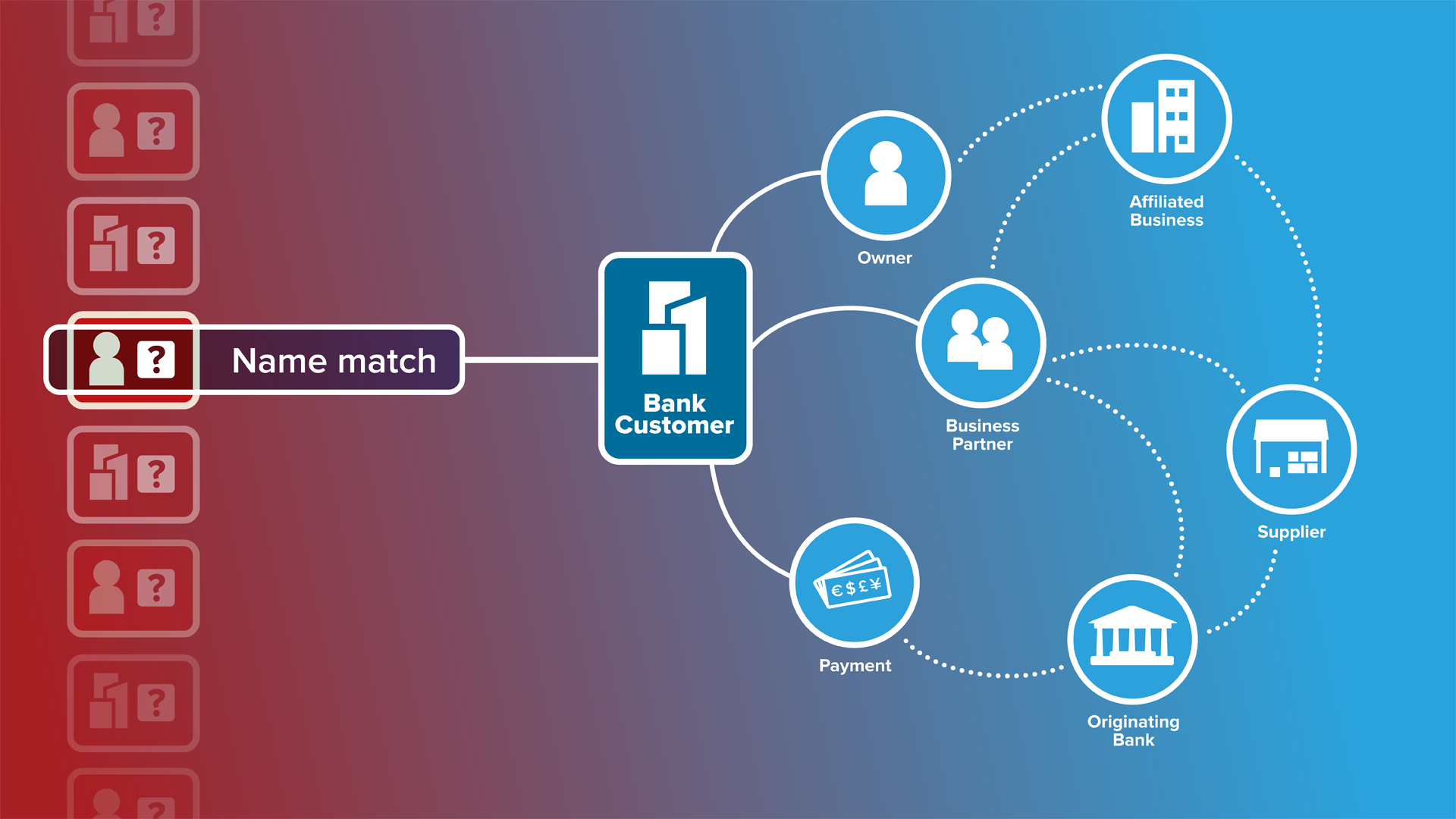
Accurate screening gives analysts more time to investigate. Quantifind’s Graphyte™ AI Risk Intelligence Platform combines Name Science™ and AI-native entity resolution with intelligence about the people, companies, and relationships behind an alert or suspicious transaction.
- Reduce false positives and free up analyst time. Name Science™ and AI-native entity resolution help distinguish genuine matches from similar names and recognize entities across aliases, languages, and spelling variations. Match explanations help analysts understand why a record matched the entity being investigated.
- Investigate the activity and relationships behind a transaction. Company, ownership, network, and adverse media intelligence help reveal direct and indirect connections among customers, businesses, suppliers, and intermediaries.
- Support decisions with traceable evidence. Supporting sources and explainable findings help analysts evaluate the information, document their rationale, and support review and audit.
What this looks like in a gold-sourcing investigation
Consider a bank reviewing a payment for a gold purchase made by its customer, Company A. Alongside customer records and trade documents, analysts can use Graphyte to examine the customer’s business relationships and potential sanctions exposure.
In the illustrative example below, Company A is connected to a Swiss refinery. The refinery sources from a UAE gold trader, which in turn has a supplier in Sudan with a money laundering risk factor. Relevant risk may sit several relationships away from the bank’s customer.
The Relationship Network brings those connections into one view, helping analysts understand the network behind the payment and identify where closer investigation is needed.
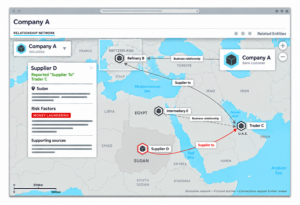
Illustrative Relationship Network showing a bank customer’s connection to a Swiss refinery, a UAE gold trader, and a Sudanese supplier with a money laundering risk factor. These relationships guide investigation; they do not establish the gold’s origin or a sanctions violation.
Analysts can review the supporting sources, distinguish allegations from established findings, and investigate whether these businesses were involved in the purchase. Customer records, payment details, and trade documents help establish the gold’s origin and whether applicable restrictions affect the transaction.
By connecting relationship intelligence with supporting evidence, Graphyte helps teams focus their investigation and explain their conclusions. The institution retains responsibility for determining which restrictions or authorizations apply and whether the transaction is permitted.
Sanctions compliance does not end with list matching. Quantifind helps teams connect the match to the risk, and the evidence to their decision.
See how Quantifind supports sanctions screening and investigations. Request a demo.